
Disordered Meaning
Mara Predicatori (2025)
(exhibition text for Franko B: I Apologise - Palazzo Lucarini Contemporary, Trevi (2025))
language: English [translation] / Italian [original]
On Display
Franko B hangs pain out on display like laundry, exposing it and letting it dry before our eyes. He hangs children's dresses, early twentieth-century dressing gowns, and household tablecloths, embroidering them with news images, symbols, slogans, and harsh, ambiguous words that cut through the air with pain, accusation, and enigma. Each piece of fabric evokes a memory engraved on an absent body; each embroidery is a blow and, at the same time, a form of healing. There is no nostalgia, but rather a re-semanticization, visual sabotage, and the rewriting of intimacy as a critical space.
The threads and works stretch from one room to the next in a continuous short circuit, arranged around the fragmented, chrome-plated sculpture of a dead child, stripped by the sea and by escape. Here, "positive" icons—poets, artists, marginal prophets—alternate with the "monstrous" ones of capitalism and power: excuses and "fuck-yous."
And then phalluses everywhere: ceramic, embroidered, sculpted, multiplied. One stands out above a prie-dieu like a weapon of symbolic reversal. The phallus, a dominant symbol of patriarchal culture, appears here simultaneously sacralized and ridiculed, emptied and celebrated: it is fetish and caricature, violence and play. On the ground, an Italy torn to pieces: ceramic fragments, shards of houses and bodies, a fractured territory and an identity composed of wounded singularities.
"Pornography" as the revelation of trauma and power
The world passes for us every day on a screen like a toxic timeline: war, sex, irony, abuse, tragedies. We watch everything, feel little, remember nothing. Franko B restores flesh and body to this disembodied media universe. Blending all this with the domestic dimension of the familiar and simple object, he transforms it into an uncanny double that awakens the repressed side we harbor deep within our psyche, allowing us to peacefully survive the horror with which each of us, deep down, can resonate and empathize.
Franko B takes this "pornography of the present"—wounded bodies, slogans of banal cruelty, explicit gay sex, icons of power or culture—and, instead of concealing shame or hope, he stitches it together. He makes visible the obsceneness that governs our emotional education, shattering categories. Violence and tenderness coexist in the same embroidery, in that act of weaving that is healing par excellence. The garment cares, but also accuses.
Victims and executioners
The body—personal and in the works—that Franko B gives us appears as a living archive: desire and wound coexist, exhibited without hierarchies, on the same symbolic, spatial, and temporal plane. Her work reveals the inhuman in the human and vice versa, exposing repressed desire and mending the unbearable we've learned to ignore, reintroducing it in the form of icons, gestures, and words. In doing so, she forces us to question what we've been taught to observe, desire, and tolerate. Trauma isn't explained, but rather traversed with discomfort and tension, in the knowledge that in the system we live in, there are no innocents. We are both victims and executioners, those who must apologize and those who await them.
Collective Guilt
In the performance I APOLOGISE, Franko B embodies collective guilt: he assumes all responsibility and, at the same time, redistributes it. He whispers or shouts intimate and disturbing apologies to the viewer, confessing traumas or evoking others, asking for forgiveness. With an "affective lie,"
he embodies an ambivalent and performative act, inviting us into a slippery, painful, and disorienting territory between good and evil, right and wrong.
It is in this ambiguous space that Franko's work invites us to stay: not to find peace, but to disorganize meaning. To relocate impulses, guilt, and desires onto new, more sincere, more unstable, and different planes. Perhaps truer?
Ambiguity as an ethical act
Franko B, therefore, does not clarify our ideas; on the contrary, he confuses them. Beneath the images lies not a message to decipher, but a minefield where fist and caress are equivalent, where guilt and pleasure overlap. It is here, in this uncertain interstice, that we recognize an authentic pedagogical space. Not that of the formal, neutral, domesticated lesson, but one that destabilizes, that challenges, that forces us to reorganize our thinking.
And it is no coincidence that—in one of the rooms—an old school table gathers together the accumulation of images of the world: fragments to be recomposed, rewritten, rethought. It is on that desk, an open metaphor for education as a continuous and affective process, that ambiguity becomes an active tool: to defuse norms and recombine signs. It is in the instability of codes, in the ambiguity and ostentation of forms and roles, that the space opens up to defuse norms and recombine desire, guilt, and power.
Art as Disobedient Pedagogy
Franko B's work thus appears as an act of organized transgression. In his punk language, which apparently misleads, defiles, and fails to console, he exposes contradiction and invites us to rethink. As bell hooks argues, it is precisely in transgression that a space opens up to imagine another world. In that slow, sewn, obstinate gesture, Franko constructs a pedagogy of trauma: a form of listening that begins with pain, but does not stop with the victim. It places us in the middle, concerns us, implicates us, calling upon our conscience and autonomous critical capacity.
Art as Intervention
Franko B's art, more than healing or provocation, seems to me to be a pure intervention. His giving voice to the generalized "pornography" of the world becomes an authentic pedagogical act because it challenges us, preventing us from remaining comfortable. It does not ask us to understand, but to choose, to look, to stay, to remember, to never look back. His works don't explain: they demand. They thrust before us the pleasure and horror we gaze upon every day without seeing, not to tell us we are guilty, but to tell us we can choose. We can feel. We can change. If we want to. If we have the courage to look (and suffer) to the very end.
(R)esist.
i Sigmund Freud, The Uncanny (Das Unheimliche, 1919), Italian translation by Marie Bonaparte, in Complete Works, volume XV, PUF, 1996.
ii Marina Giordano, Trame d'art. Il tessuto nell'arte contemporanea, postmedia books, 2012;
iii Elio Vi orini, Uomini e no, Milan, Mondadori, 1945.
iv Judith Butler, Gender Trouble. Il genere in rivolta, Italian translation, Milan, Feltrinelli, 1990.
v bell hooks, Teaching to Transgress. Education as a Practice of Freedom (Teaching to Transgress, 1994), Rome-Milan, Meltemi, 2020.
see Paulo Freire, Pedagogy of Autonomy: Knowledge Necessary for Educational Practice, Turin, EGA-Gruppo Abele, 2014.
language: English [translation] / Italian [original]
Disordinare il Senso
Mara Predicatori (2025)
In mostra
Franko B stende il dolore in mostra come bucato, esponendolo e lasciandolo asciugare sotto i nostri occhi. Appende abitini da bambini, vestaglie del primo Novecento, tovaglie domestiche, ricamando su di esse immagini di cronaca, simboli, slogan e parole dure e ambigue che tagliano l'aria con dolore, accusa ed enigmaticità. Ogni stoffa evoca una memoria incisa su un corpo assente; ogni ricamo è un colpo inferto e, al tempo stesso, una forma di cura. Non c'è nostalgia, ma risemantizzazione, sabotaggio visivo e riscrittura dell'intimità come spazio critico.
I fili e le opere si tendono da una stanza all'altra in un cortocircuito continuo, disposti attorno alla scultura frammentata e cromata di un bambino morto, spogliato dal mare e dalla fuga. Qui si alternano icone "positive" – poeti, artisti, profeti marginali – e quelle "mostruose" del capitalismo e del potere: scuse e fuck-you.
E poi falli ovunque: in ceramica, ricamati, scolpiti, moltiplicati. Uno campeggia sopra un inginocchiatoio come un'arma di rovesciamento simbolico. Il fallo, segno dominante della cultura patriarcale, appare qui insieme sacralizzato e ridicolizzato, svuotato e celebrato: è feticcio e caricatura, violenza e gioco. A terra, un'Italia fatta a pezzi: frammenti di ceramica, scaglie di case e corpi, un territorio spezzato e un'identità composta da singolarità ferite.
“Pornografia” come svelamento del trauma e del potere
Il mondo scorre per noi ogni giorno su uno schermo come una timeline tossica: guerra, sesso, ironia, abusi, tragedie. Guardiamo tutto, sentiamo poco, ricordiamo niente. Franko B ridona carne e corpo a questo universo mediatico disincarnato. Miscelando il tutto con la dimensione domestica dell'oggetto familiare e semplice, lo trasforma in un doppio perturbantei che risveglia il lato rimosso che culliamo nel fondo della nostra psiche, permettendoci di sopravvivere in pace all'orrore con cui ognuno di noi, in fondo, può risuonare ed empatizzare.
Franko B prende questa "pornografia del presente" – corpi feriti, slogan di crudeltà banale, sesso gay esplicito, icone del potere o della cultura – e, invece di nascondere vergogna o speranza, la cuce. Rende visibile l'osceno che governa la nostra educazione emotiva, facendo saltare le categorie. Violenza e tenerezza convivono nello stesso ricamo, in quell'atto dell'intessere che è curaii per eccellenza. L'abito accudisce, ma anche accusa.
Vittime e carnefici
Il corpo – personale e delle opere – che Franko B ci dona appare come un archivio vivente: desiderio e ferita vi convivono, esposti senza gerarchie, sullo stesso piano simbolico, spaziale e temporale. Il suo lavoro rivela il disumano dell'umano e viceversa, esponendo il desiderio rimosso e ricucendo l'insopportabile che abbiamo imparato a ignorare, rimettendolo in circolo sotto forma di icona, gesto, parola. Così facendo, ci costringe a rimettere in discussione ciò che ci è stato insegnato a guardare, desiderare, tollerare. Il trauma non viene spiegato, ma attraversato con disagio e tensione, nella consapevolezza che nel sistema in cui viviamo non esistono innocenti. Siamo insieme vittime e carneficiiii, coloro che devono chiedere scusa e coloro che le attendono.
La colpa collettiva
Nella performance I APOLOGISE, Franko B si fa corpo di colpa collettiva: si assume ogni responsabilità e, al tempo stesso, la redistribuisce. Sussurra o urla scuse intime e disturbanti al visitatore, confessando traumi o evocandone altri, chiedendo perdono. Con una "menzogna
affettiva", incarna un atto ambivalente e performativo, invitandoci in un territorio scivoloso, dolente e disorientante tra bene e male, giusto e sbagliato.
È in questo spazio ambiguo che l'opera di Franko ci invita a stare: non per trovare pace, ma per disordinare il senso. Per ricollocare pulsioni, colpe, desideri su piani nuovi, più sinceri, più instabili, altri. Forse più veri?
L’ambiguità come atto etico
Franko B, dunque, non schiarisce le idee, anzi, confonde. Sotto le immagini non si trova un messaggio da decifrare, ma un campo minato dove pugno e carezza si equivalgono, dove colpa e piacere si sovrappongono. È qui, in questo interstizio incerto, che si riconosce uno spazio pedagogico autentico. Non quello della lezione formale, neutrale, addomesticata, ma quello che destabilizza, che mette in crisi, che costringe a riorganizzare il pensiero.
E non a caso – in una delle sale – un vecchio tavolo scolastico raccoglie l'accumulo delle immagini del mondo: frammenti da ricomporre, riscrivere, ripensare. È su quel banco, metafora aperta dell'educazione come processo continuo e affettivo, che l'ambiguità diventa strumento attivo: per disinnescare le norme e ricombinare i segni. È nell'instabilità dei codici, nell'ambiguità e ostentazione delle forme e dei ruoli, che si apre lo spazio per disinnescare le norme e ricombinare desiderio, colpa, potereiv.
Arte come pedagogia disobbediente
Il lavoro di Franko B appare così come un atto di trasgressione organizzata. Nel suo linguaggio punk che apparentemente diseduca, sporca e non consola, mostra la contraddizione e ci invita a un ripensamento. Come sostiene bell hooksv, è proprio nella trasgressione che si apre uno spazio per immaginare un altro mondo. In quel gesto lento, cucito, ostinato, Franko costruisce una pedagogia del trauma: una forma di ascolto che parte dal dolore, ma non si ferma alla vittima. Ci mette in mezzo, ci riguarda, ci implica, chiamando in causa la nostra coscienza e l'autonoma capacità criticavi.
Arte come Intervento
L'arte di Franko B, più che cura o provocazione, mi sembra un puro intervento. Il suo dare voce alla "pornografia" generalizzata del mondo diventa atto pedagogico autentico perché ci chiama in causa, impedendoci di restare comodi. Non chiede di capire, ma di scegliere, di guardare, di stare, di ricordare, di non voltarsi più. Le sue opere non spiegano: esigono. Ci sbattono davanti il piacere e l'orrore che guardiamo ogni giorno senza vedere, non per dirci che siamo colpevoli, ma per dirci che possiamo scegliere. Possiamo sentire. Possiamo cambiare. Se lo vogliamo. Se abbiamo il coraggio di guardare (e patire) fino in fondo.
(R)esistendo.
i Sigmund Freud, Il perturbante (Das Unheimliche, 1919), trad. it. Marie Bonaparte, in Opere complete, tomo XV, PUF, 1996.
ii Marina Giordano, Trame d'ar sta. Il tessuto nell'arte contemporanea, postmedia books, 2012;
iii Elio Vi orini, Uomini e no, Milano, Mondadori, 1945.
iv Judith Butler, Gender Trouble. Il genere in rivolta, trad. it., Milano, Feltrinelli, 1990.
v bell hooks, Insegnare a trasgredire. L’educazione come pra ca della libertà (Teaching to Transgress, 1994), Roma-Milano, Meltemi, 2020.
vi Paulo Freire, Pedagogia dell’autonomia. Saperi necessari per la pra ca educa va, Torino, EGA-Gruppo Abele, 2014.
exhibition:
-
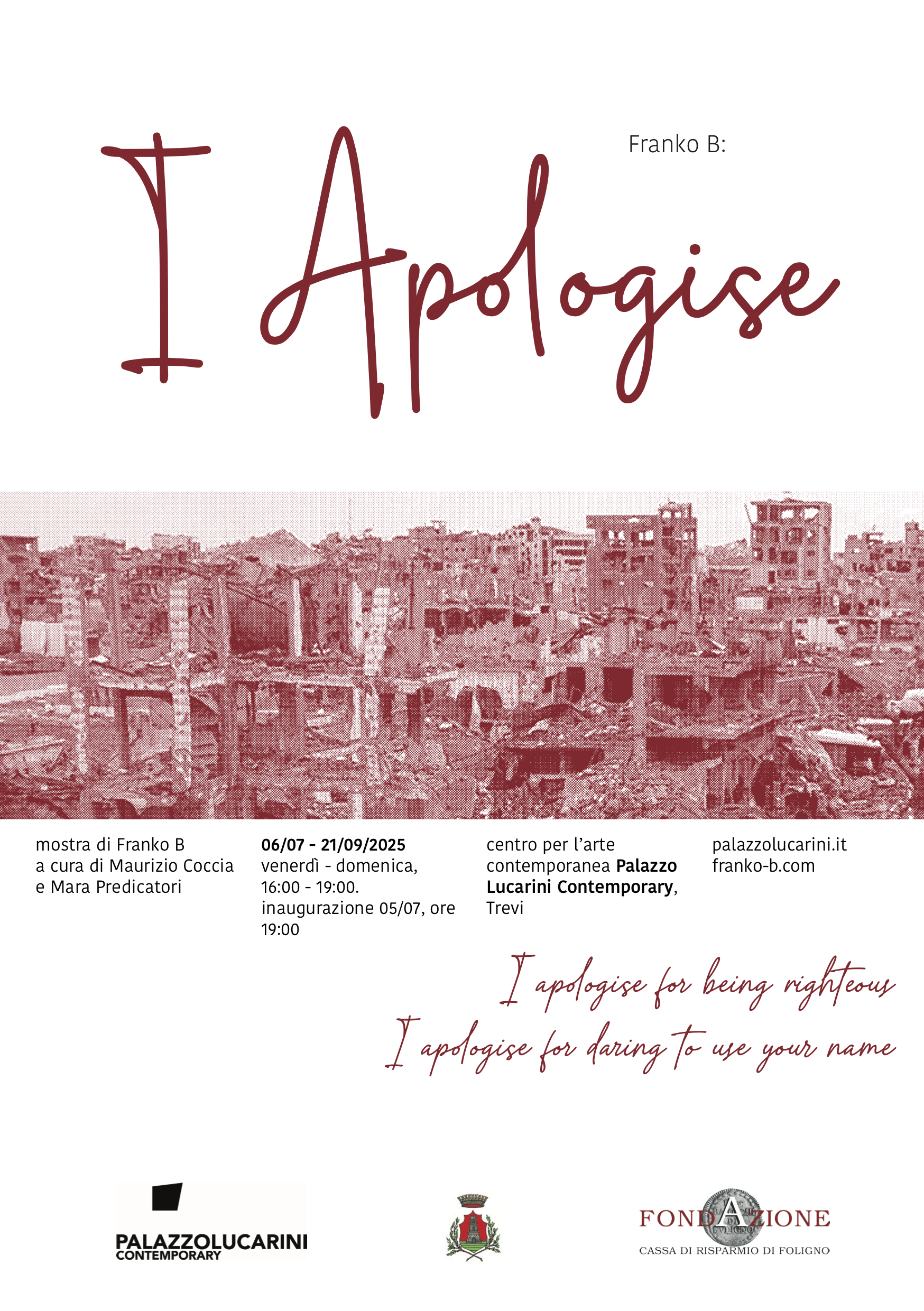
• I Apologise
Palazzo Lucarini Contemporary, Trevi (2025)
related texts:
-
• I Apologise, l’Innocenza Offesa [I Apologise, Offended Innocence]
Filippo Mollea Ceirano (2025)
-
• We Apologise
Maurizio Coccia (2025)
-
• I Apologise
Franko B (2024)
related works:
-
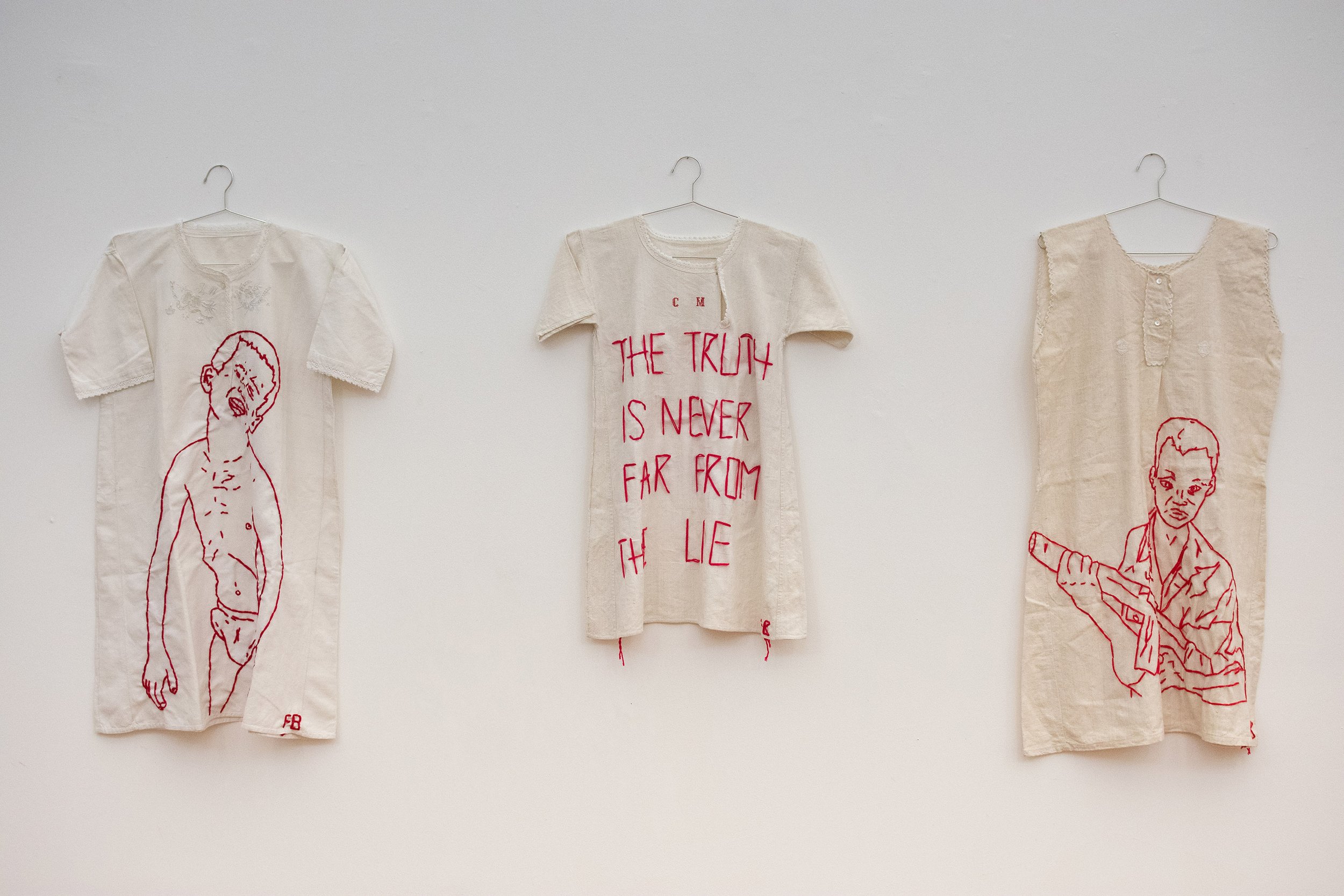
• Here Comes The Rain
series of stitch drawings on vintage nightshirts (2023-2025)
-
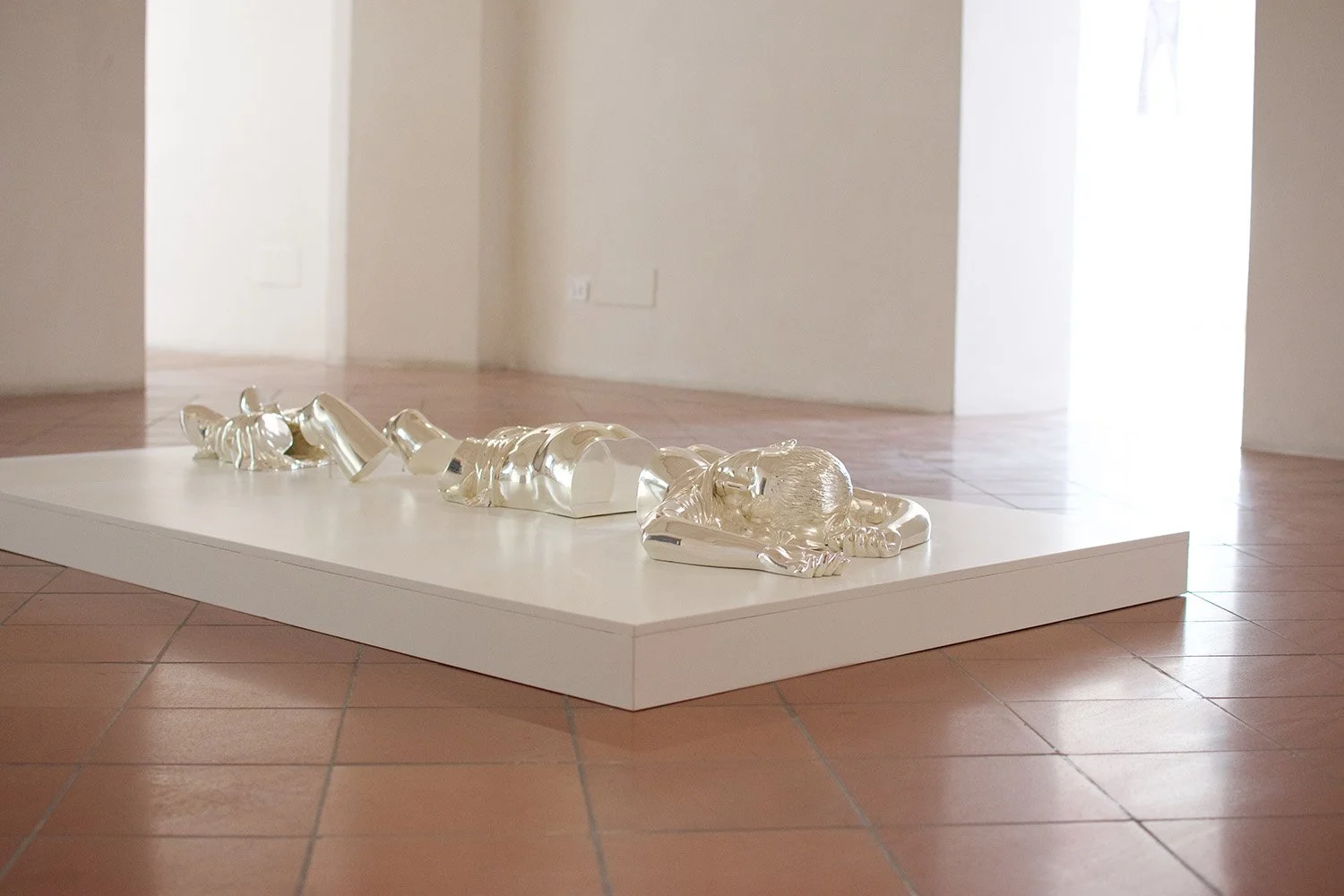
• Sleeping Beauty Version 2
sculpture (2016)
-
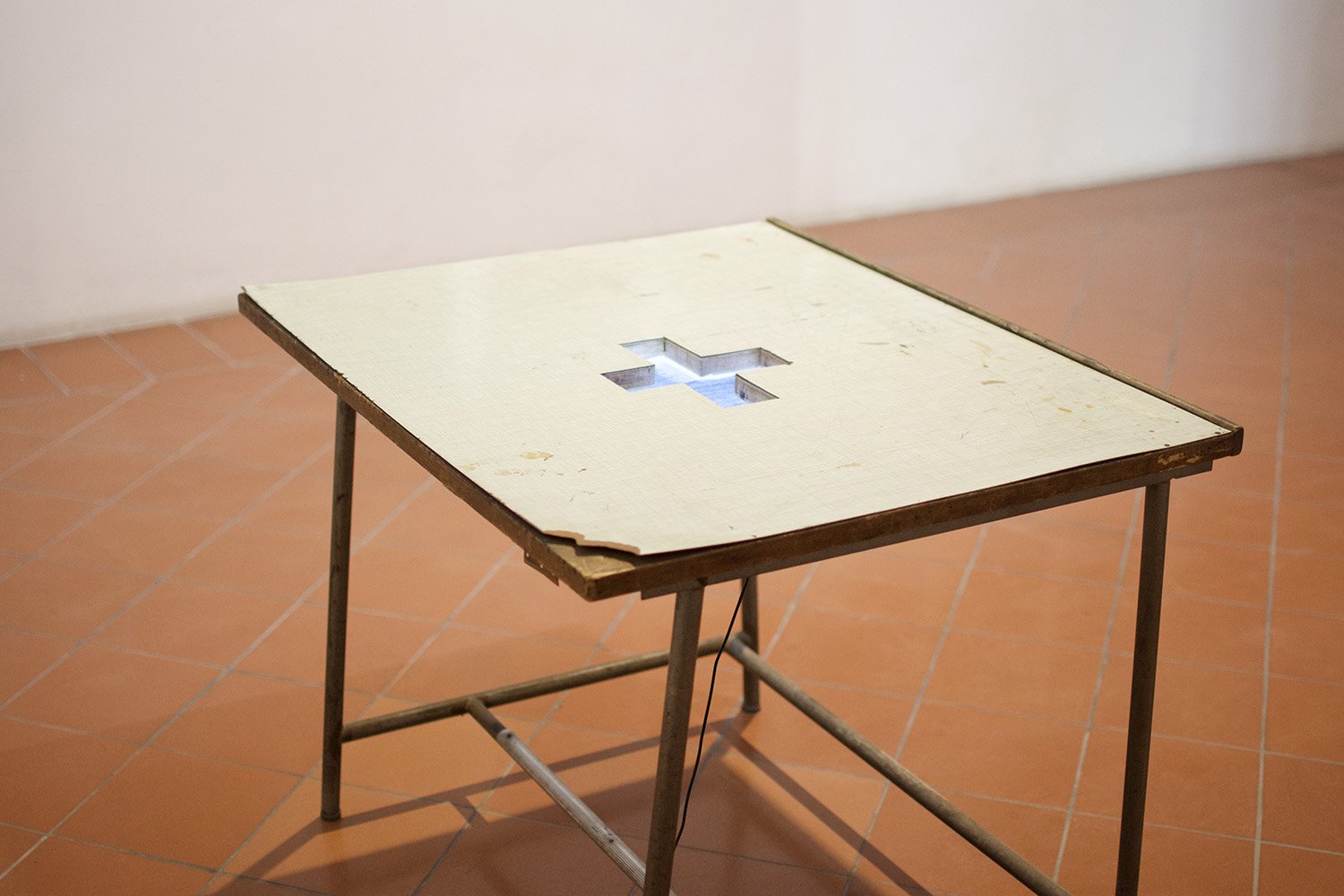
• Time Travels
series of multi-media sculptures (2018-2020)