I’m So Fucking Queer
Franko B (2026)
For many years my practice has dealt with the notion of power: who has and doesn’t have it (whether consciously or unconsciously), its abuses, its symbols. I use a multitude of different visual strategies (such as performance, ceramics, sculpture, painting, stitching on canvas and clothing) to denounce and to bear witness to the state of the world as I see it. I use art as language to speak about our time, reflecting on themes such as homelessness, refugees, child soldiers, wars and conflicts, colonial histories, displacement, bigotry, personal histories and more.
Recently, I have started to use depictions of the phallus in my work as a metaphor for power - but also desire. To me, the phallus is a symbol of patriarchy and institutional control, particularly in relation to my personal experience growing up in an institution run by Roman Catholics in Northern Italy (as well as in the context of 1960s-1970s Italy, its abuses and its hypocrisies).
My mother rejected me when I was born. I was unwanted and an embarrassment, placed out of sight in these institutions - not necessarily by my mother’s explicit wishes as much as by result of her circumstances. While the institutions were managed by both male and female staff, they all perpetuated the same patriarchal power dynamics, regardless of their role - be they nuns or priests, teachers, social workers, psychiatrists, law enforcers. The patriarchal power structure was enforced without question.
When I grew up and left the institution, I came to realise that I was considered strange. I didn’t fit in. I was socially inadequate, deficient, abnormal. One could say I was queer. When I talk about queerness here, I am using the word in its original sense of strange, odd or out of the ordinary, rather than as a synonym for homosexual, or its contemporary usage as an umbrella identifier for sexual and gender minorities. I didn’t know this word at the time.
Art saved my life.
When I was 16, I ran away. I began to educate myself, unconsciously at first, in the use of language as a form of resistance. I found acceptance through music and subculture. This is where I found the confidence to be myself, and I became infatuated with the Punk movement that began in England in 1976-77, listening to groups like the Sex Pistols, the Clash, Siouxsie and the Banshees and the Damned.
My earliest inspirations came before this - they were music and writing of the late 1960s and 70s; writers and musicians such as Patty Smith, Jack Kerouac, William boroughs, Lou Reed and more. These are some of the voices I discovered as a teenager, who helped me realise I was not the only outsider or stranger or “Queer” (in the old sense of the word). I later came to consider them to be the first Punks.
I moved to London in 1979 (homeless and penniless, after escaping military service in Italy), I discovered a less commercial form of Punk that was emerging at the time - a more political, anti-war, anti-Thatcher Punk movement was taking hold. Anarchist punk groups such as Crass, Poison Girls, Conflict and Flux of Pink Indians to name few, as well as post-punk and ‘new wave’ movements mainly via music and experimental underground art scenes - all of these inspired my development, which turned towards visual art after a chance encounter with a stranger in 1983 who invited me to ceramics classes. Three years later I was in Art School.
Language is a virus. Meanings evolve over time. Queerness has changed over time.
“Queer is a word of uncertain origin that had entered the English language by the early 16th century, when it was primarily used to mean strange, odd, peculiar or eccentric.
By the late 19th century it was being used colloquially to refer to same-sex attracted men. While this usage was frequently derogatory, queer was simultaneously used in neutral and affirming ways. […]
In the 1960s and 1970s, as sexual and gender minorities fought for civil rights and promoted new ways of being in society, we also sought new names for ourselves. Gay liberationists began to reclaim queer from its earlier hurtful usages […]
[in the early 1990s] Queer began to be used in a different way: not as a synonym for gay, but as a critical and political identity that challenged normative ideas about sexuality and gender. […]
From the early 2000s, it became more common to use queer as an umbrella term that was inclusive of the spectrum of sexual and gender identities represented in the LGBTIQA+ acronym.” 1
[1] The history of the word 'queer' - Timothy W. Jones, La Trobe University (2023) - https://www.latrobe.edu.au/news/articles/2023/opinion/the-history-of-the-word-queer
In my opinion, the contemporary sense of the word queer has become overused to the extent that it has lost meaning. It feels that it has become trendy to be queer, that queerness is an identity to conform to. To me, this is the antithesis of queerness.
Queerness is an attitude as is Punk. One can be queer regardless of sexuality; Punk and queerness can be the same thing - to be different, to be an outsider, an eccentric. Punk is, a way to be me. A “fuck you” to power, to be oneself, to be queer.
Franko b
London June 2026
related works:
-
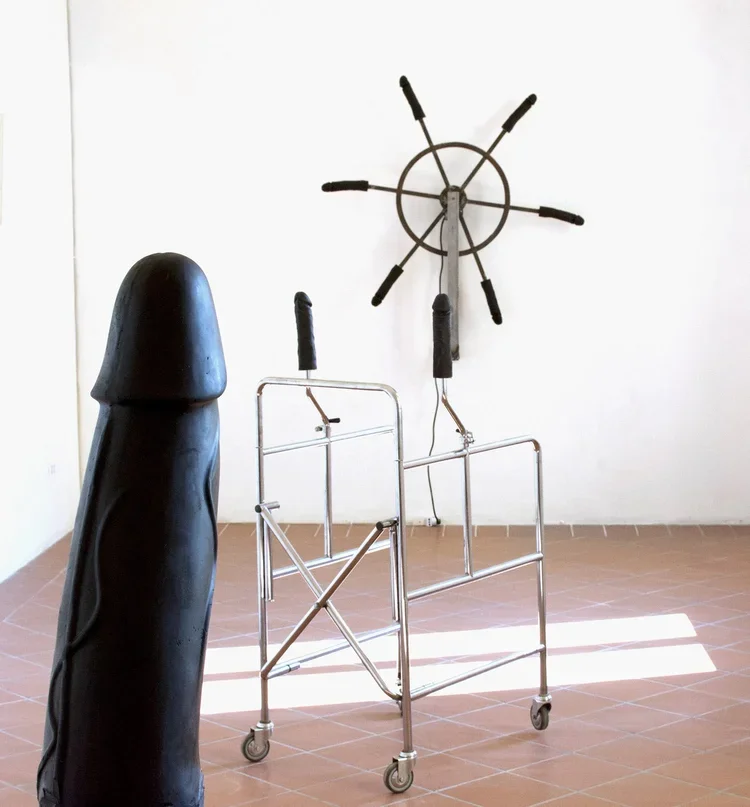
• I'm So Fucking Queer
installation (2025)
-
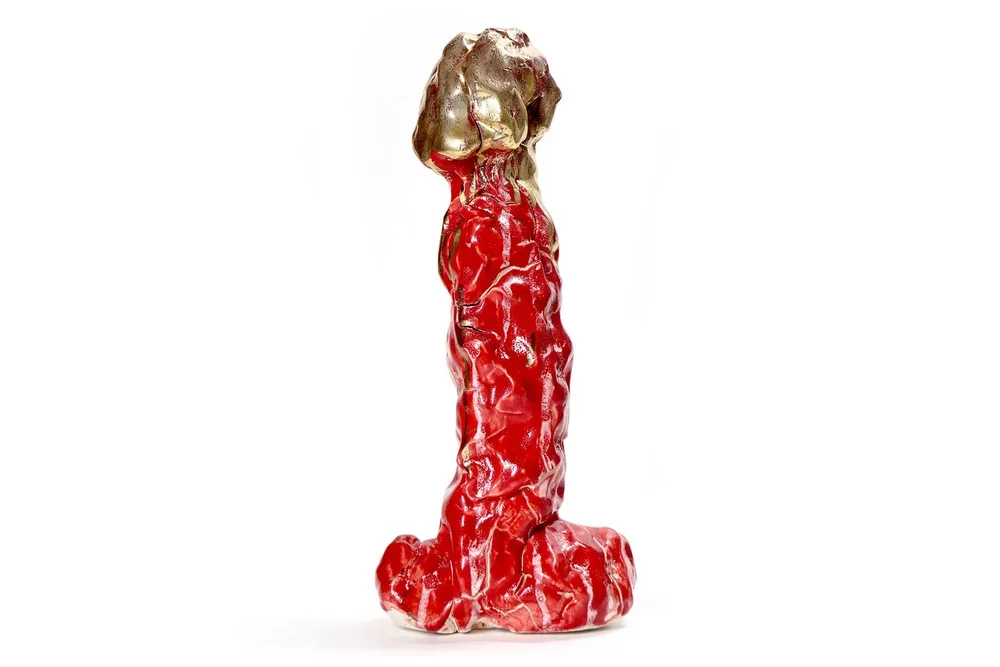
• Cocks
series of ceramic sculptures (2021-2024)
-
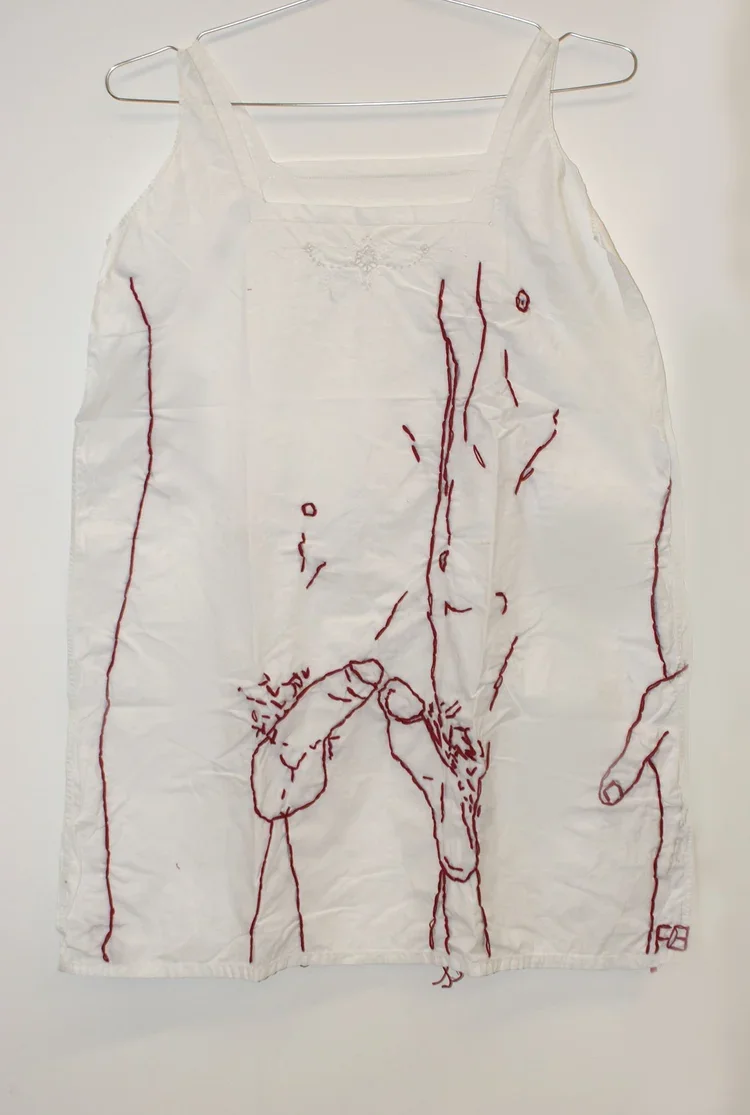
• Here Comes the Rain
installation / series of embroidered garments (2023-2025)
-
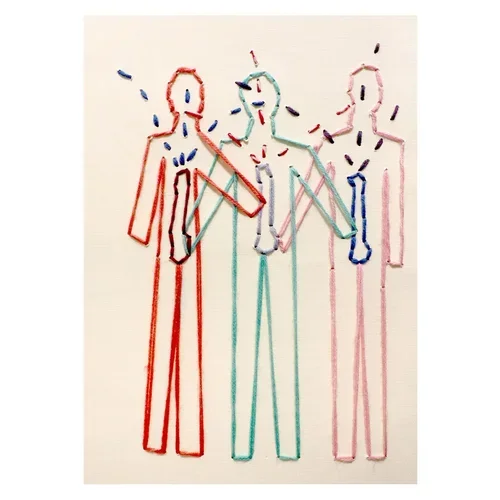
• Stitches on Paper
ongoing series of stitched drawings (2012-2026)
-
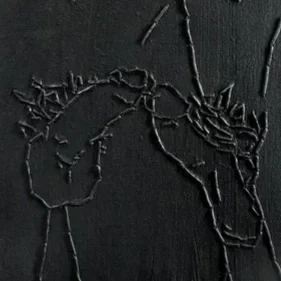
• Stitched Black Paintings
series of paintings (2023-2025)
-
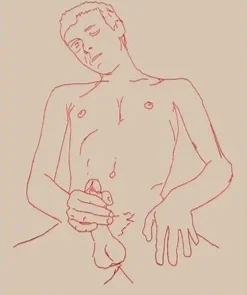
• Stitches on Canvas
ongoing series of embroidered drawings on unprimed canvases (2009-2026)